
What Is a Keyword Count Checker?
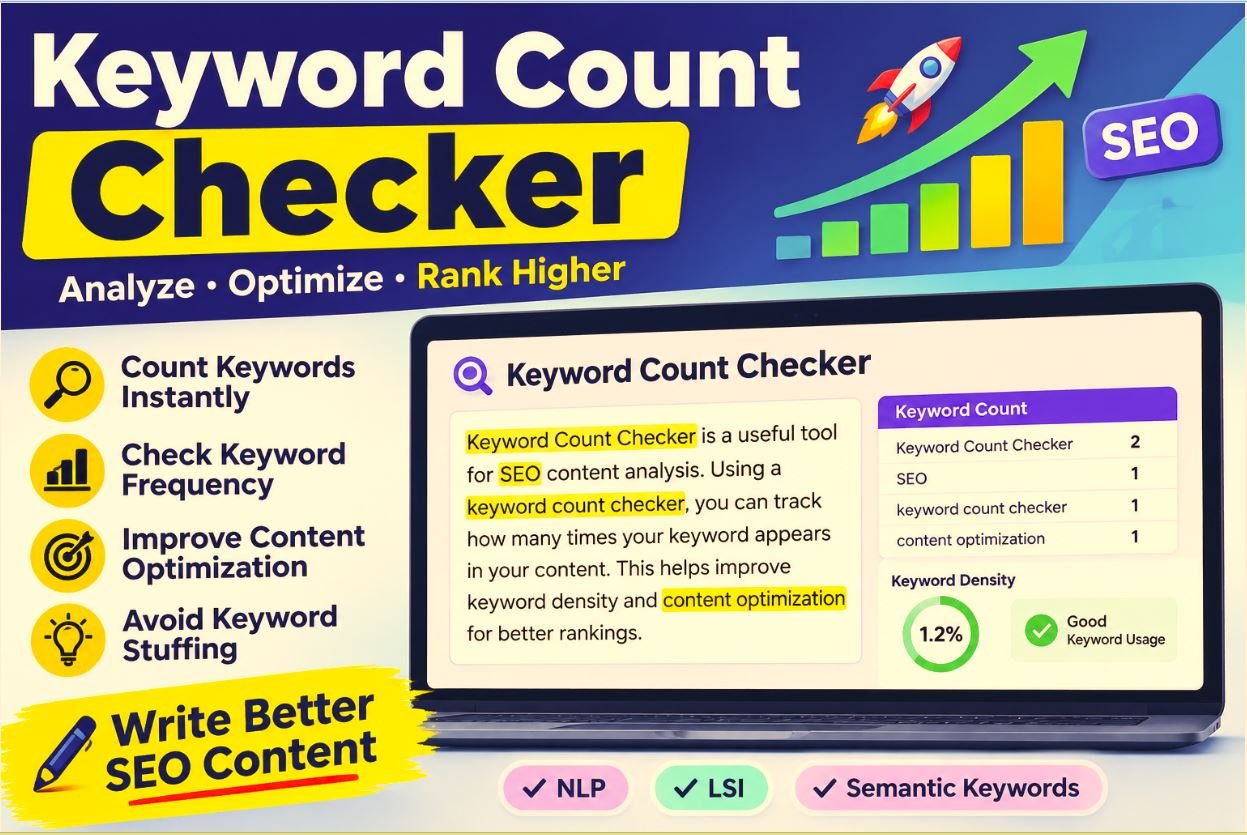
A keyword count checker is a tool that measures how many times a specific word or phrase appears in your content. It can calculate keyword frequency, keyword density, and total occurrences, helping writers understand whether their target terms are used naturally and consistently throughout an article, webpage, product description, or blog post.
For SEO, keyword counting is more useful when combined with context. Modern search engines evaluate topics, entities, intent, synonyms, related phrases, and overall content quality rather than relying only on repetition. A keyword frequency checker therefore works best as a content-analysis aid instead of a tool for forcing keywords into every paragraph.
- 🔎 Find keyword frequency quickly
- 📊 Measure keyword density
- 📝 Analyze written content
- 🎯 Check target phrases
- 🚀 Support on-page SEO
- 🧠 Understand content relevance
- ✨ Improve content naturally
- 🔗 Discover related terminology
Why Is Keyword Counting Important for SEO?
Keyword counting helps identify whether your primary keyword appears enough to establish topical relevance without making the writing sound repetitive. It can also reveal missing terminology, unusually frequent phrases, and opportunities to improve headings, introductions, body copy, image alt text, and other on-page SEO elements.
Effective optimization is not simply about reaching a particular percentage. Search engines increasingly understand natural language, semantic relationships, and search intent. Using relevant NLP keywords, LSI keywords, entities, synonyms, and semantic terms can create a more comprehensive page. This makes a keyword count checker useful for quality control rather than keyword stuffing.
- 🎯 Match search intent
- 📈 Strengthen topical relevance
- 🧩 Identify content gaps
- 🔤 Review keyword variations
- 🧠 Support NLP optimization
- 🌐 Improve semantic coverage
- ⚖️ Avoid excessive repetition
- ✅ Audit on-page content
How Does a Keyword Count Checker Work?
Most keyword counting tools analyze the text you provide and identify repeated words or phrases. Depending on the tool, you may see total word count, individual keyword occurrences, keyword density, unique words, phrase frequency, and sometimes a ranking of the most frequently used terms. Some tools also distinguish between single words and multi-word phrases.
For example, if your target keyword is “word count checker” and it appears ten times in a 1,000-word article, its basic density is 1%. However, that number alone does not determine whether the content is optimized. A strong analysis also considers readability, placement, variations, semantic keywords, headings, and whether the content genuinely answers the reader’s question.
- ⚙️ Paste or upload content
- 🔢 Count keyword occurrences
- 📐 Calculate keyword density
- 📚 Analyze common phrases
- 🧾 Review total word count
- 🧠 Compare related terms
- 🔍 Spot repetitive language
- 📋 Export useful insights
Keyword Density vs. Keyword Frequency
Keyword frequency means the number of times a keyword appears in a piece of content. Keyword density expresses that frequency as a percentage of the total word count. These measurements are related but not identical. A keyword may appear frequently in a long article while still having a relatively low density.
There is no universal keyword-density percentage that guarantees higher rankings. Search algorithms assess meaning, relevance, quality, usefulness, and intent. Instead of obsessing over a specific number, use frequency data to detect unnatural repetition and confirm that important concepts are represented appropriately. This balanced approach also improves readability for human visitors.
- 🔢 Frequency counts occurrences
- 📐 Density uses percentages
- 📏 Word count affects density
- ⚠️ Avoid keyword stuffing
- 👀 Prioritize reader experience
- 🧠 Consider semantic context
- ✍️ Keep language natural
- 📊 Compare content intelligently
How to Use a Keyword Count Checker Effectively
Start by identifying the primary keyword and the search intent behind it. Then analyze your draft to see where the term appears. Check important locations such as the title, opening section, relevant headings, body text, and conclusion. After that, examine variations and related concepts rather than simply adding the exact keyword repeatedly.
A useful workflow combines keyword counting with broader content optimization. You can compare your page against competing content, identify semantic gaps, and make sure your article covers important subtopics. Even when experimenting with a tool or workflow such as zuhio, the objective should remain the same: create helpful, comprehensive, and natural content.
- 🎯 Define your primary keyword
- 🔍 Analyze the complete draft
- 🏷️ Review important placements
- 🧩 Add relevant variations
- 🧠 Expand semantic coverage
- 📚 Cover related subtopics
- 👤 Write for real readers
- 🚫 Remove forced repetition
NLP, LSI, and Semantic Keywords Explained
NLP keywords are terms that help search systems understand language and context. LSI keywords, a commonly used SEO term, generally refers to words and phrases related to the main topic. Semantic keywords go further by covering concepts, entities, attributes, questions, and related terminology that naturally belong within the subject.
For a keyword count checker article, related terms might include keyword density, keyword frequency, SEO content analysis, search intent, content optimization, on-page SEO, keyword research, phrase frequency, semantic SEO, and topical relevance. Including these concepts naturally gives search engines stronger contextual signals without relying on repetitive exact-match keywords.
- 🧠 Use natural language
- 🔗 Include related concepts
- 🧩 Cover topic entities
- 🔤 Add keyword variations
- 🎯 Address user intent
- 📚 Build topical depth
- 🌐 Strengthen semantic relevance
- ✨ Avoid artificial phrasing
Common Keyword Counting Mistakes to Avoid
One common mistake is treating keyword density as a ranking formula. Writers may repeatedly insert an exact phrase simply because a tool shows a low count. This can produce awkward sentences, poor readability, and an over-optimized appearance. Another mistake is ignoring synonyms, related questions, entities, and supporting concepts that make content more useful.
Another problem is counting words without considering placement or meaning. A keyword repeated many times in irrelevant sections does not necessarily strengthen topical relevance. Similarly, removing every repeated term can make content less clear. The better strategy is to use important phrases where they genuinely help readers understand the subject.
- 🚫 Don’t stuff keywords
- ⚠️ Don’t chase arbitrary percentages
- 🛑 Don’t sacrifice readability
- 🔄 Avoid unnecessary repetition
- 🧩 Don’t ignore related terms
- 🎯 Don’t forget search intent
- 📖 Don’t copy competitor wording
- ✅ Always prioritize usefulness
Best Practices for Keyword Count Checker Tools
Use a keyword count checker as part of a broader SEO workflow. Begin with keyword research, understand search intent, create a useful outline, write naturally, and then analyze the finished draft. Check primary keywords alongside secondary phrases and semantic terms. Finally, edit for clarity, accuracy, originality, and user experience.
The best content is comprehensive without being repetitive. A keyword checker can highlight patterns that are difficult to notice manually, but human judgment remains essential. Review your headings, internal links, examples, questions, and supporting information before publishing. When used correctly, tools like these can make optimization faster while preserving an authentic writing style.
- 🔍 Audit before publishing
- 📊 Check primary keywords
- 🧠 Review semantic terms
- ✍️ Edit for readability
- 🔗 Improve internal linking
- 🎯 Confirm search intent
- 📱 Check mobile readability
- 🚀 Re-audit after updates
FAQ: Keyword Count Checker
What is a keyword count checker?
A keyword count checker identifies how often words or phrases appear in content. Many tools also calculate keyword density and total word count.
What is keyword density?
Keyword density is the percentage of a page’s words represented by a particular keyword or phrase. It is useful for analysis but should not be treated as a guaranteed ranking formula.
How many times should I use a keyword?
There is no universal ideal number. Use your primary keyword naturally where it helps communicate the topic, while incorporating relevant synonyms and semantic phrases.
Can keyword stuffing hurt SEO?
Yes. Excessive or unnatural keyword repetition can make content difficult to read and may be considered manipulative optimization. Focus on relevance, usefulness, and natural language.
Are LSI keywords still important?
The term “LSI keywords” is widely used in SEO, although modern search optimization is better understood through semantic relevance, related concepts, entities, and search intent.
Can a keyword counter improve rankings?
A keyword counter does not directly improve rankings. It helps you analyze content so you can make better optimization decisions alongside research, quality writing, technical SEO, and user-focused improvements.
Should I check competitor keyword counts?
Competitor analysis can reveal topics and terminology worth considering, but copying their keyword frequency is not recommended. Build original content that satisfies the searcher’s needs more effectively.
Is keyword frequency the same as keyword density?
No. Frequency is the number of occurrences, while density is the proportion of occurrences relative to total word count.
How does a keyword count checker support AI-powered search?
AI-powered search systems benefit from clear, comprehensive, context-rich content. Keyword counting can support this process by helping you identify important terms, but semantic depth and useful answers are more important than repetition.
What should I do after checking keyword frequency?
Review the results alongside search intent, readability, topical coverage, internal linking, headings, and semantic relevance. Then make only the edits that improve clarity and usefulness.