
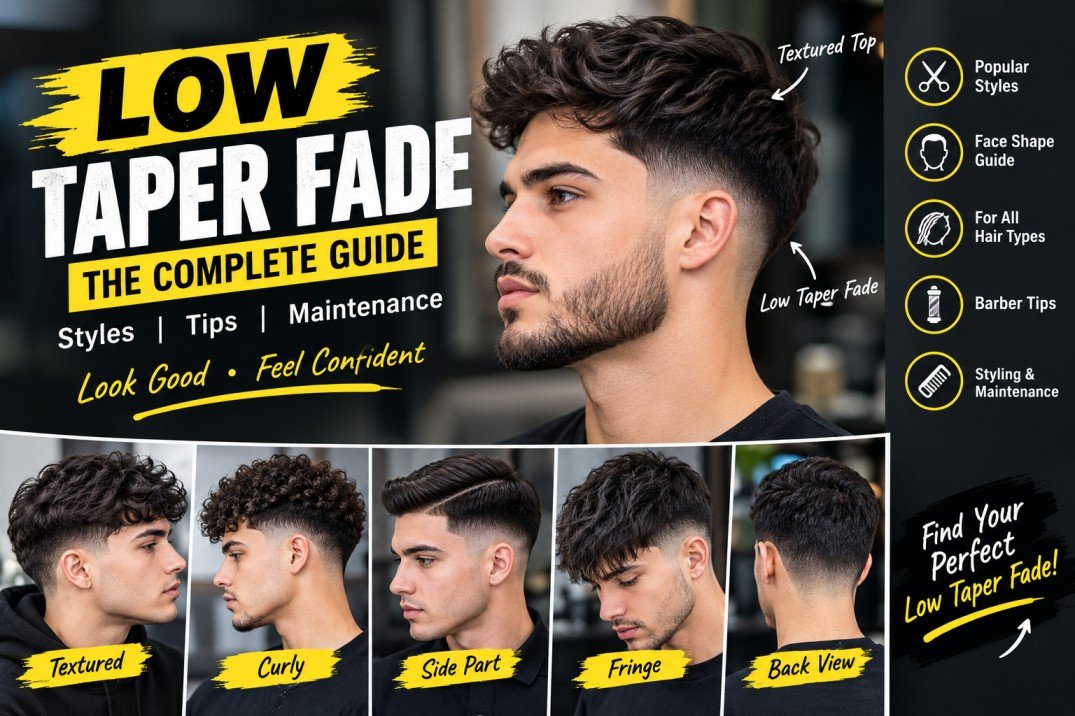
The low taper fade is a clean, versatile men’s haircut that gradually reduces hair length around the sideburns, temples, ears, and neckline while preserving more length and weight on the sides and top. Unlike a higher fade, its transition stays low, creating a subtle appearance that works for casual, professional, and modern hairstyles.
For barbers, the low taper is also a useful foundation because the taper can be customized according to hair texture, density, hairline, face shape, and the client’s preferred finish. The top can remain short, textured, curly, wavy, slicked back, or considerably longer.
What Is a Low Taper Fade?
A low taper fade is a haircut where the hair gradually becomes shorter toward the lower edges of the head. The blend is concentrated around the sideburns and neckline rather than removing significant weight from the entire side panel. This creates a controlled transition while keeping the haircut natural and balanced.
The word “low” describes the position of the taper, while “fade” describes the gradual transition between different lengths. Depending on the desired result, a barber may finish the taper with a #1, #0.5, zero, or skin-level finish. Terminology can vary between barbershops, so a reference photograph can prevent confusion.
- Low placement around the ears
- Gradual clipper blending
- Clean sideburn area
- Tapered neckline
- More side weight retained
- Flexible top length
- Natural-looking transition
- Customizable finish
Low Taper Fade vs. Low Fade
Although the names sound similar, a low taper fade and a conventional low fade can produce noticeably different silhouettes. A low taper generally focuses on localized areas such as the sideburns and nape, whereas a low fade may create a more continuous faded section around the lower sides and back.
The low taper is therefore useful for clients who want cleaner edges without dramatically reducing the fullness of their sides. For a barber, understanding this distinction is important because simply interpreting “low fade” as “low taper” can result in removing more hair than the client expected.
- Taper stays more compact
- Low fade removes more side weight
- Taper preserves fuller sides
- Low fade has stronger contrast
- Taper looks subtle from front
- Fade creates a wider gradient
- Both use graduated blending
- Always confirm the desired result
Best Low Taper Fade Styles
One of the biggest advantages of the low taper fade is its compatibility with different hairstyles. The same taper can support a textured crop, French crop, quiff, comb over, slick back, messy top, buzz cut, curls, waves, or longer layered hair. The top determines much of the haircut’s personality.
A classic low taper gives a conservative appearance, while textured styling or a sharp line-up creates a more contemporary look. Curly and coily hair can retain substantial natural volume while the taper cleans the perimeter. This adaptability makes the haircut suitable for many grooming preferences.
- Classic low taper
- Low taper with crop
- Low taper with curls
- Low taper with waves
- Low taper with quiff
- Low taper with slick back
- Low taper with buzz cut
- Low taper with textured top
Low Taper Fade for Different Hair Types
A low taper fade can be adapted to straight, wavy, curly, and coily hair. Straight hair often highlights the precision of the blend, while wavy hair adds natural movement. Curly and coily textures can benefit from perimeter cleanup because the barber can sharpen the outline without unnecessarily removing volume from the top.
Hair density should also influence the cutting approach. Thick hair may require controlled debulking before blending, while finer hair generally benefits from conservative clipper work. Barbers should consider the client’s natural growth pattern, cowlicks, curl direction, and hairline before establishing the taper.
- Straight hair
- Wavy hair
- Curly hair
- Coily hair
- Thick hair
- Fine hair
- Dense hair
- Textured hair
Low Taper Fade for Different Face Shapes
Face shape can influence how a low taper fade should be customized, although there is no single taper that belongs exclusively to one face type. Oval, square, round, rectangular, heart, and diamond-shaped faces can all work with the haircut when the barber balances the top length and side volume appropriately.
For rounder faces, additional controlled height on top can visually lengthen the hairstyle. For longer or rectangular faces, excessive height may not be necessary. Square faces can often support a structured taper, while softer styling can create a more relaxed appearance.
- Oval face shape
- Round face shape
- Square face shape
- Rectangle face shape
- Diamond face shape
- Heart face shape
- Adjust top height
- Balance side volume
How Barbers Create a Low Taper Fade
A professional low taper fade requires controlled sectioning, appropriate clipper guards, and careful blending. The barber normally establishes the taper around the sideburns and neckline before progressively removing visible weight. Clipper-over-comb, guards, trimmers, and detail work can all be used depending on the client’s hair density and requested finish.
The key is not simply making the hair shorter; it is creating a seamless transition without visible steps or harsh patches. Experienced barbers frequently alternate between guards and use the corners of the clipper blade for precision around curves, temples, and difficult growth patterns.
- Consult before cutting
- Establish the taper area
- Start with conservative removal
- Use appropriate clipper guards
- Blend visible weight
- Detail the sideburns
- Clean the neckline
- Check the blend from all angles
How to Ask Your Barber for a Low Taper Fade
Clear communication can make a major difference. Instead of saying only “give me a low taper,” explain where you want the taper, how short the lowest section should be, how much side length you want to retain, and what style you prefer on top. A photograph is particularly useful for communicating the desired shape.
A simple request could be: “I want a low taper around the sideburns and neckline, keep the sides fairly full, blend it smoothly, and leave the top textured.” If you want a skin finish, #0.5, or #1 taper, mention that specifically because the shortest point changes the overall appearance.
- Say “low taper”
- Specify the taper height
- Mention the shortest guard
- Keep or remove side weight
- Explain the top length
- Describe your styling preference
- Bring a reference photo
- Ask for a natural blend
Low Taper Fade Maintenance and Styling
A low taper fade is relatively easy to maintain because the transition is concentrated around the perimeter. However, the exact maintenance schedule depends on hair growth speed, taper length, skin exposure, and personal preference. A guarded taper can generally retain a softer appearance as it grows, while a very short or skin finish may require more frequent touch-ups.
For daily styling, choose products according to hair texture rather than simply copying another person’s routine. Matte clay or texture powder can work for textured styles, while a lightweight cream can enhance waves or curls. A comb and styling cream may suit a cleaner finish. Keep the scalp and hair clean, and avoid excessive product buildup.
- Refresh the taper regularly
- Keep sideburns neat
- Maintain the neckline
- Use suitable styling products
- Match products to hair texture
- Wash away product buildup
- Protect natural hair texture
- Schedule professional touch-ups
Why Choose a Low Taper Fade?
The low taper fade combines a clean perimeter with substantial freedom on top. It can look understated or modern depending on the styling, making it adaptable to school, work, social occasions, formal events, and everyday wear. Its low placement also makes it an approachable option for someone trying a fade for the first time.
For hair cutters, the style provides considerable room for customization. The barber can modify taper height, shortest length, side weight, neckline shape, top texture, and styling direction. The result can therefore be tailored rather than treated as a one-size-fits-all haircut.
- Clean and versatile
- Works with many textures
- Suitable for many face shapes
- Preserves side fullness
- Flexible top styling
- Easy to personalize
- Beginner-friendly haircut choice
- Barber-friendly technique
Final Thoughts
The low taper fade is more than simply a short haircut around the ears. It is a controlled blending technique that creates clean edges while preserving the character and volume of the hairstyle. Whether paired with curls, waves, a textured crop, slick back, quiff, or short haircut, the low taper can be customized to suit the wearer. For the best result, communicate the taper height, shortest length, side fullness, neckline preference, and top style clearly. If you are a barber, focus on gradual blending, natural growth patterns, hair density, and symmetry. A well-executed low taper fade should look clean from every angle while still feeling natural and easy to maintain.