
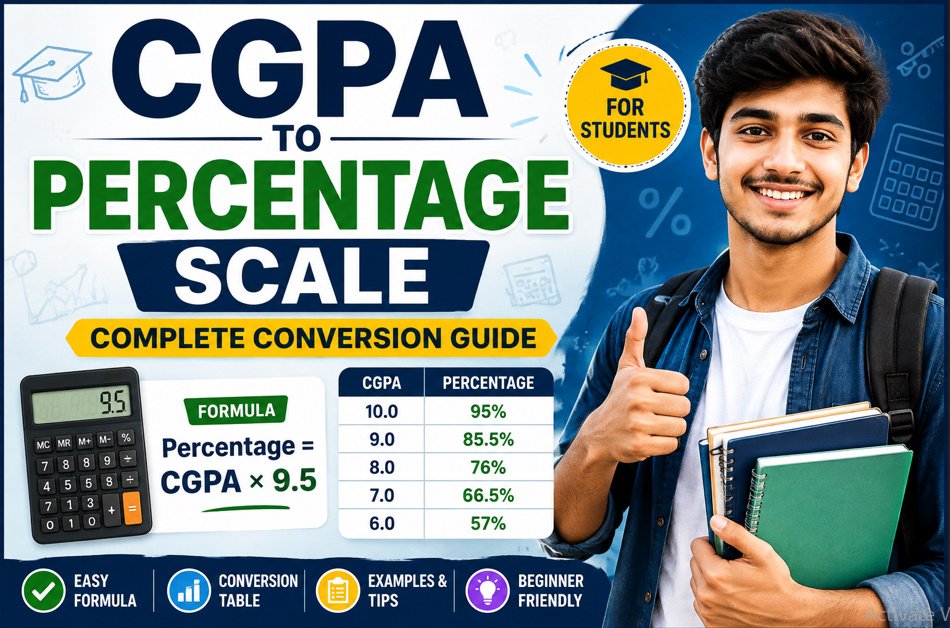
Your CGPA to Percentage Scale plays an important role in college admissions, scholarships, competitive exams, and job applications. Many universities award grades in the form of CGPA, while organizations often request percentages. Understanding the correct conversion method helps you avoid mistakes and present your academic performance accurately.
Whether you are a school student, undergraduate, postgraduate, or preparing documents for higher education, learning the CGPA to percentage conversion process is essential. This guide explains different conversion methods, university rules, formulas, examples, and practical tips in simple language.
What Is CGPA to Percentage Scale?
CGPA (Cumulative Grade Point Average) is a grading system that measures a student’s overall academic performance across multiple semesters. Instead of showing marks in percentage, it represents performance on a fixed grading scale such as 4-point, 5-point, or 10-point systems. Many educational institutions worldwide use CGPA because it provides a standardized evaluation.
However, many employers, universities, and government organizations still require percentage marks. Therefore, students need to convert their CGPA into percentage using approved formulas. The conversion method depends on the education board or university, so always verify the official guideline before submitting academic documents.
Key Points
- CGPA means Cumulative Grade Point Average.
- Used by schools and universities worldwide.
- Represents academic performance.
- Different institutions use different scales.
- Percentage is required for many applications.
- Conversion depends on university rules.
- Official formulas should always be preferred.
- Accurate conversion avoids admission issues.
Why Is CGPA Converted into Percentage?
Many organizations continue to evaluate applicants based on percentage because it is easier to compare candidates from different educational systems. Government jobs, scholarships, visa applications, and international universities often request percentage instead of CGPA.
Converting CGPA into percentage ensures consistency when academic records are compared. Since different universities use different grading scales, understanding the proper conversion formula helps students present accurate academic achievements without confusion.
Key Points
- Required for higher education.
- Helpful during job applications.
- Needed for scholarship eligibility.
- Used in government recruitment.
- Simplifies academic comparison.
- Accepted internationally.
- Supports transcript evaluation.
- Prevents calculation mistakes.
Common CGPA to Percentage Conversion Formula
The most commonly used formula in many educational systems is:
Percentage = CGPA × 9.5
For example, if your CGPA is 8.2, then:
8.2 × 9.5 = 77.9%
This formula is popular because several educational boards adopted it after analyzing average student performance. However, it is not universal. Some universities use different multipliers or unique conversion formulas depending on their grading policies.
Key Points
- Percentage = CGPA × 9.5
- Easy to calculate.
- Widely used in education.
- Not applicable everywhere.
- Always verify university rules.
- Some institutes use custom formulas.
- Check official transcripts.
- Avoid unofficial calculators.
Different Universities Use Different CGPA Scales
Every educational institution may follow its own grading policy. Some universities use a 10-point CGPA scale, while others use 4-point or 5-point GPA systems. As a result, conversion formulas also differ significantly.
For example, engineering universities, medical colleges, business schools, and international institutions often publish official conversion tables instead of a single multiplication formula. Students should always refer to their university’s academic regulations before converting grades.
Key Points
- Universities have unique grading systems.
- 10-point scales are common.
- Some use 4-point GPA.
- Others follow 5-point scales.
- Official conversion tables may exist.
- Policies change over time.
- Always check university guidelines.
- Never assume one formula fits all.
Step-by-Step Method to Calculate Percentage from CGPA
Calculating your percentage is straightforward once you know your university’s approved formula. Begin by identifying your CGPA and confirming the official conversion method provided by your institution.
Next, apply the formula carefully and verify the result. If your university offers an official calculator or transcript conversion table, compare your calculation to ensure complete accuracy before using it in applications.
Key Points
- Find your CGPA.
- Check university guidelines.
- Use the correct formula.
- Perform the calculation.
- Verify the answer.
- Round values if required.
- Compare with official records.
- Save your calculations.
CGPA to Percentage Conversion Examples
Examples make the conversion process easier to understand. Suppose your university follows the formula CGPA × 9.5. A CGPA of 7.5 becomes 71.25%, while 9.0 converts to 85.5%.
If your institution follows another conversion rule, simply replace the multiplier or follow the official conversion chart. Practical examples help students avoid confusion during academic documentation.
Key Points
- CGPA 6.5 = 61.75%
- CGPA 7.0 = 66.5%
- CGPA 7.5 = 71.25%
- CGPA 8.0 = 76%
- CGPA 8.5 = 80.75%
- CGPA 9.0 = 85.5%
- CGPA 9.5 = 90.25%
- Check official formulas.
Mistakes to Avoid During CGPA Conversion
Many students assume that every university uses the same formula, which often results in incorrect percentage calculations. Using unofficial calculators or outdated grading policies can also create problems during admissions or employment verification.
Always verify the latest academic regulations from your institution. If multiple formulas are available, consult your examination office or official university website before submitting converted percentages.
Key Points
- Avoid guessing formulas.
- Don’t use random calculators.
- Verify grading policies.
- Check updated regulations.
- Confirm transcript values.
- Review calculations twice.
- Follow official instructions.
- Keep supporting documents.
Benefits of Understanding the CGPA to Percentage Scale
Learning the CGPA to Percentage Scale helps students confidently complete admission forms, scholarship applications, competitive exams, and employment documents. It reduces errors and ensures academic records meet institutional requirements.
A clear understanding of grading systems also improves transparency when comparing educational performance across schools, universities, and countries. Accurate conversions strengthen credibility and make academic achievements easier to evaluate.
Key Points
- Better academic planning.
- Easier admission process.
- Supports scholarship applications.
- Improves job opportunities.
- Helps international students.
- Ensures accurate documentation.
- Saves time.
- Reduces conversion errors.
Frequently Asked Questions (FAQs)
What does CGPA stand for?
CGPA stands for Cumulative Grade Point Average, which measures overall academic performance.
Is CGPA the same as GPA?
No. GPA usually refers to one semester, while CGPA represents the cumulative performance across all semesters.
Can I always multiply CGPA by 9.5?
No. The 9.5 multiplier is not universal. Always follow your institution’s official conversion formula.
Why do universities ask for percentage?
Many universities, employers, and government organizations use percentage as a standard method for comparing applicants.
Which grading scales are commonly used?
Common grading systems include 4-point GPA, 5-point GPA, and 10-point CGPA scales.
Is an online CGPA calculator reliable?
Only if it follows your university’s official conversion method
Conclusion
Understanding the CGPA TO PERCENTAGE SCALE is essential for every student. Whether applying for higher education, scholarships, internships, or employment, accurate conversion ensures your academic achievements are represented correctly. Since grading systems differ across institutions, always rely on your university’s official conversion formula instead of general assumptions. By following the correct method, checking official guidelines, and verifying calculations, you can confidently convert your CGPA into percentage and avoid unnecessary errors in important academic and professional applications.